CORE SERVICES
Regulatory Licensing
SCA, FCA, CySEC & global licensing
Research & Analysis
AI-driven market intelligence
Marketing Management
Growth, brand & digital acquisition
TRADING TECHNOLOGY
Automated Strategies
Algo execution & HFT infrastructure
EA Development
Custom MT4/MT5 expert advisors
Our Story
The journey behind Algoment
Our Philosophy
Principles that guide every decision
Our Process
How we deliver from brief to launch
Our Partners
Technology partners we trust
Protect Your Book.
Control Every Position.
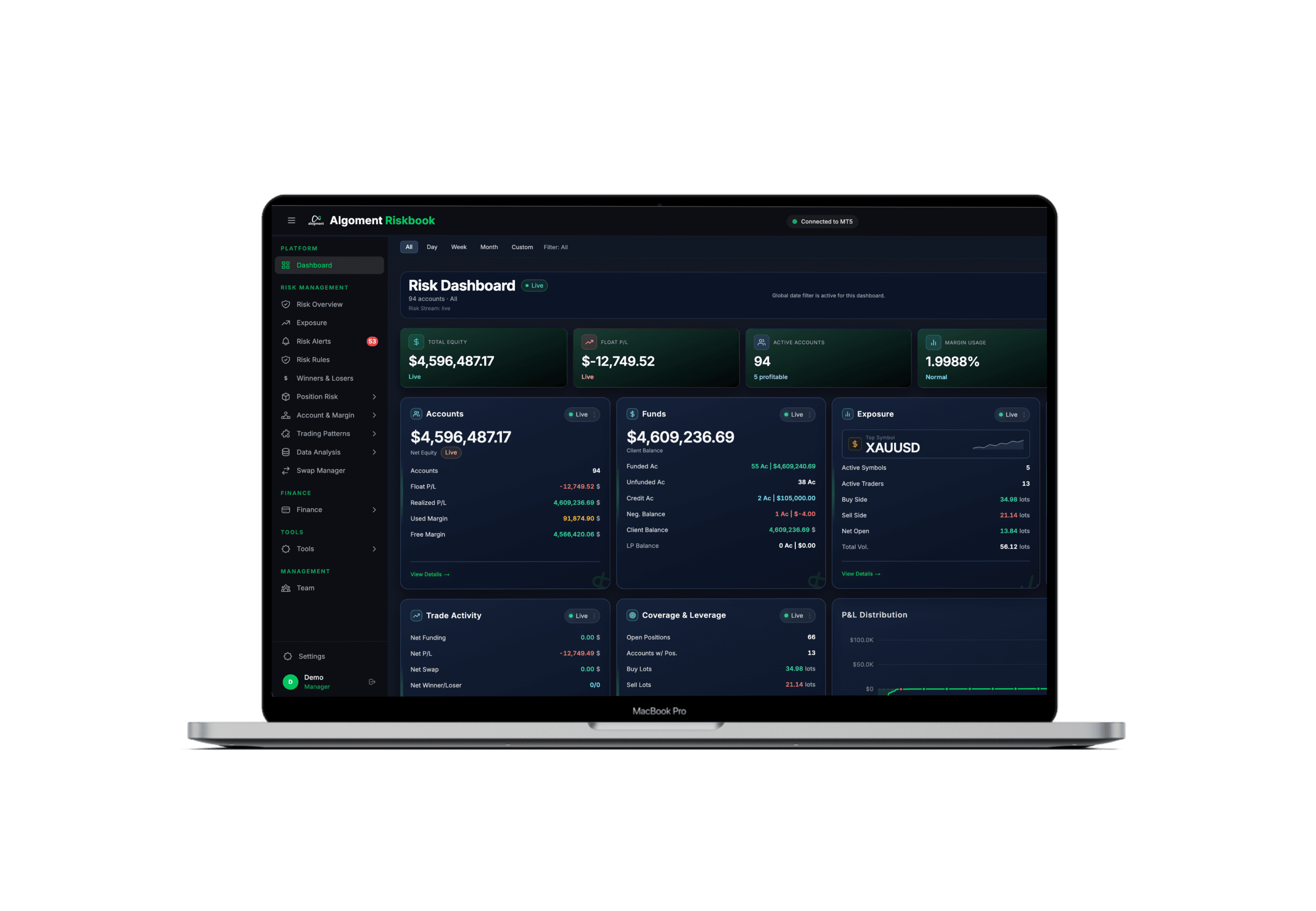
Algoment's risk management infrastructure gives brokerages real-time exposure monitoring, automated hedging, dynamic A/B-book routing, and regulator-ready reporting — all managed from a single, intelligent dealing desk dashboard.
What We Deliver
Full-Spectrum Risk Control
Built for Brokers
Real-Time Exposure Monitoring
Live position aggregation across all client accounts, instruments, and trading groups — with instant P&L, net exposure, and Greeks visualised on a single dealing desk dashboard.
Real-Time Exposure Monitoring
Live position aggregation across all client accounts, instruments, and trading groups — with instant P&L, net exposure, and Greeks visualised on a single dealing desk dashboard.
Automated Hedging Engine
Rule-based and threshold-triggered hedging that automatically routes residual exposure to your A-book LPs — reducing manual intervention and human error on the dealing desk.
Automated Hedging Engine
Rule-based and threshold-triggered hedging that automatically routes residual exposure to your A-book LPs — reducing manual intervention and human error on the dealing desk.
A-Book / B-Book Routing
Dynamic client segmentation routes profitable traders to A-book and loss-making flow to B-book — maximising your brokerage revenue while controlling risk within defined limits.
A-Book / B-Book Routing
Dynamic client segmentation routes profitable traders to A-book and loss-making flow to B-book — maximising your brokerage revenue while controlling risk within defined limits.
Margin & Stop-Out Controls
Configurable margin call levels, stop-out thresholds, and force-close logic with real-time alerts and automated execution when exposure limits are breached.
Margin & Stop-Out Controls
Configurable margin call levels, stop-out thresholds, and force-close logic with real-time alerts and automated execution when exposure limits are breached.
Regulatory Risk Reporting
Automated generation of daily risk reports, capital adequacy calculations, and regulator-ready exposure summaries for ADGM, CySEC, ASIC, and FSA compliance.
Regulatory Risk Reporting
Automated generation of daily risk reports, capital adequacy calculations, and regulator-ready exposure summaries for ADGM, CySEC, ASIC, and FSA compliance.
Position Limits & NOP Controls
Configurable net open position limits per instrument, per client group, and per trading session — with hard blocks and escalation alerts for the risk team.
Position Limits & NOP Controls
Configurable net open position limits per instrument, per client group, and per trading session — with hard blocks and escalation alerts for the risk team.
Our Process
From Audit to Live Protection
Risk Audit
We review your current book composition, client flow profile, LP structure, and existing risk controls to identify gaps and opportunities.
Risk Framework Design
A bespoke risk management framework is designed around your business model — defining routing rules, limits, hedging thresholds, and reporting cadence.
System Integration
The risk engine is integrated with your trading platform (MT4/MT5/cTrader), LP connections, and back-office — tested under simulated stress conditions.
Live Monitoring & Support
Go live with 24/7 risk desk support, real-time dashboards, automated alerts, and quarterly risk reviews to keep your framework current.
The Problem
Why Brokerage Books
Bleed Without Proper Risk Controls
Unhedged Exposure Is a Silent Time Bomb
Brokerages with manual dealing desks routinely accumulate unhedged directional exposure — until a single volatile news event wipes out weeks of revenue in minutes.
Unhedged Exposure Is a Silent Time Bomb
Brokerages with manual dealing desks routinely accumulate unhedged directional exposure — until a single volatile news event wipes out weeks of revenue in minutes.
Client Segmentation Done Wrong Destroys Margins
B-booking profitable traders and A-booking losers is the fastest way to destroy your brokerage revenue. Without data-driven segmentation, most brokers get this backwards.
Client Segmentation Done Wrong Destroys Margins
B-booking profitable traders and A-booking losers is the fastest way to destroy your brokerage revenue. Without data-driven segmentation, most brokers get this backwards.
No Real-Time Margin Visibility
Manual margin monitoring with end-of-day reconciliation leaves brokerages exposed to intra-day margin breaches — with stop-outs happening after the damage is done.
No Real-Time Margin Visibility
Manual margin monitoring with end-of-day reconciliation leaves brokerages exposed to intra-day margin breaches — with stop-outs happening after the damage is done.
Regulatory Risk Reporting Is Manually Intensive
Meeting ADGM, CySEC, ASIC, or FSA risk reporting requirements with manual processes and spreadsheets consumes compliance team hours and introduces reporting errors.
Regulatory Risk Reporting Is Manually Intensive
Meeting ADGM, CySEC, ASIC, or FSA risk reporting requirements with manual processes and spreadsheets consumes compliance team hours and introduces reporting errors.
Siloed Systems Create Blind Spots
When your trading platform, risk engine, and LP connections don't talk in real time, exposure accumulates in the gaps — invisible until it's too late to hedge.
Siloed Systems Create Blind Spots
When your trading platform, risk engine, and LP connections don't talk in real time, exposure accumulates in the gaps — invisible until it's too late to hedge.
Delayed Hedging Amplifies Losses
Manual hedging decisions introduce critical seconds of delay during fast markets — turning manageable exposure into significant P&L swings on the dealing desk.
Delayed Hedging Amplifies Losses
Manual hedging decisions introduce critical seconds of delay during fast markets — turning manageable exposure into significant P&L swings on the dealing desk.
FAQ
Frequently Asked
Questions
Is Your Brokerage Book
Truly Protected?
Book a free risk audit with our dealing desk team — we'll assess your current exposure model and identify where your P&L is leaking.